01
Owned the outcome
Took Verata from 100+ discovery interviews to 30+ paying customers across PE and search firms, including two of the ten largest PE firms. Core subscription ARR roughly doubled, ~$52K → ~$110K (Jun 2025 → Sep 2026).
Product Engineer · New York City
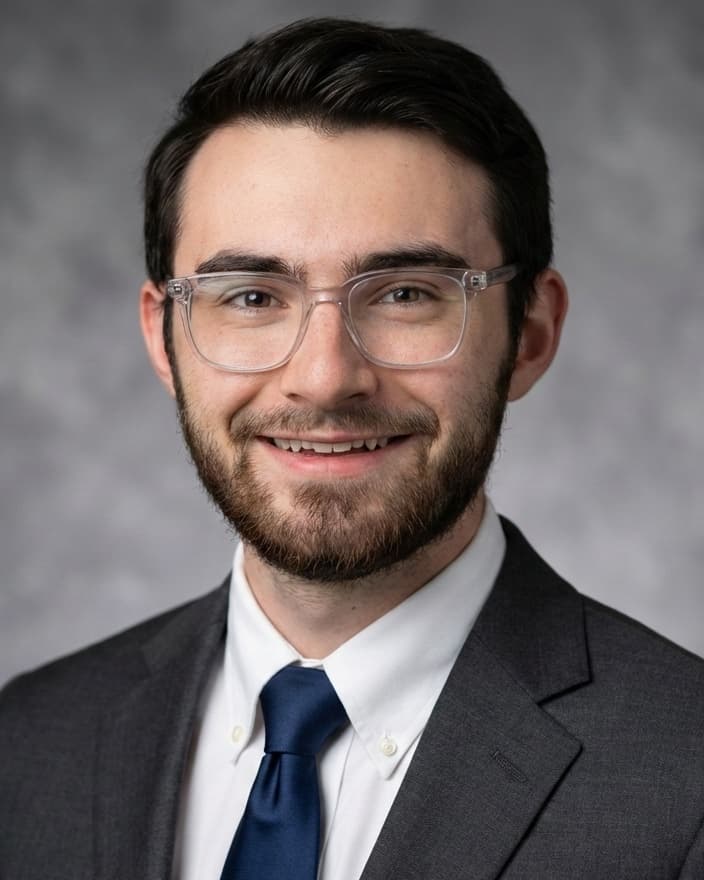
Princeton computer scientist and co-founder of Verata (YC W23), a people-and-company data platform for private-equity talent teams and executive-search firms.
I led product, design, sales, and our data and AI research, and personally built our AI sourcing and evaluation systems. Now I'm looking for my next product engineering role in New York.
Proof points
Took Verata from 100+ discovery interviews to 30+ paying customers across PE and search firms, including two of the ten largest PE firms. Core subscription ARR roughly doubled, ~$52K → ~$110K (Jun 2025 → Sep 2026).
Customer requests shipped in 1–2 weeks. I designed a 103-screen applicant-tracking product in 2 days, and it went from decision to launch in 8 weeks.
Solo-built two AI systems in about 3 months (~100K lines, 726 commits, 2,000+ tests). One turns a role brief into a sourced executive shortlist for a few dollars per search.
Showed that the platform's legacy candidate scorer ranked a client's real hire decisions backwards (AUC 0.178, n=14). My corrected system scored 0.740 on the same labels.
Selected work
Case study 01
A two-founder company that gives PE talent partners and executive recruiters partner-level market knowledge: executive profiles with transaction timelines, revenue estimates with visible comps, backchannel reference finding, network mapping and an applicant-tracking system.
“This is the best product I've ever used.”
Talent partner, mid-market PE firm
“I can find the same people, if not better ones, in Verata within a couple of hours, compared with recent graduates working LinkedIn Recruiter for days.”
Head of talent, growth-equity firm
“Every result is relevant.”
Talent team, global PE firm
Case study 02
In 2026 I wrote two AI systems end to end. One turns a company and a role ("CEO of a paper company") into a ranked, evidenced shortlist of real executives. The other rebuilds a dated timeline of what a company did from its employees' role descriptions, with every fact linked to a verbatim quote.
Case study 03
I write the test plan first, cap the budget, and report the unflattering answer. Most quality wins are unglamorous, and the worst outcome is shipping a confident number that's wrong.
Research & speaking
Verata × HSiQ · Feb 2026
Does CEO background predict PE exit success?
Lead author
A study of 12,174 PE-backed CEO appointments (2000–2018), co-published with Hunt Scanlon's research arm. About 23 primary tests plus robustness checks, with false-discovery-rate control: 4 of 23 traits survive, and career traits explain under 1% of exit variance. Red-teamed and corrected before release.
Read the study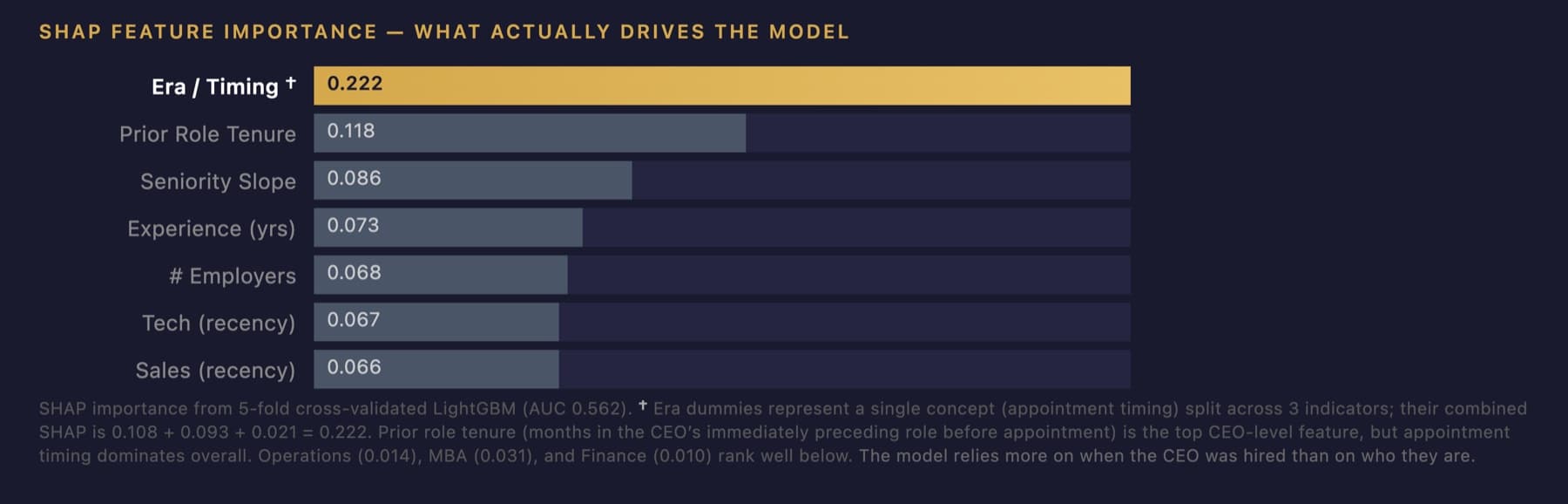
WINE 2023 · arXiv
Co-author with Linda Cai and S. Matthew Weinberg
Grew out of my Princeton M.S.E. thesis in algorithmic game theory.
arXiv 2309.14555A Hunt Scanlon webinar (Dec 2023) on where large language models help private-equity firms, and where they still fall short.
How Verata went from an idea to a venture-backed company, and advice for first-time founders.
Background
M.S.E., Computer Science
Princeton University
GPA 3.883. Graduate coursework in NLP, systems & ML, computer vision and algorithms. Thesis became a WINE 2023 paper.
B.S.E., Computer Science
Princeton University
Four years of Mandarin, including a summer in Beijing.
Co-founder & CTO
Verata (AiFlow Inc.), YC W23
Assistant in Instruction
Princeton Computer Science
Taught full-stack development and algorithmic game theory.
Presales engineer intern
Laiye (AI & automation)
Beyond the work
I'm a New York urban explorer. My favorite weekends go deep into outer-borough enclaves, to the corners of the city most people never see and the neighborhoods that don't make the guidebooks.
At home it's a full house: a giant, very fluffy Great Pyrenees mix, a cat who runs the place, and a large aquarium I'm always tinkering with. I also spent years walking dogs at NYC animal shelters.
Giant · fluffy · opinionated
Part livestock guardian, part golden retriever. Takes guarding our home very seriously, and naps very seriously too.
Actual head of household
Unimpressed by the dog, the fish and most of my product decisions.
A small ecosystem
A large tank that rewards patience, careful measurement and not changing too many variables at once.
NYC animal shelters
Years of walks with shelter dogs waiting for a home, one block at a time.
The hidden side of NYC
Picking a neighborhood and walking it. Enclaves, markets and streets that feel like a different city.
Fast, deceptive, humbling
The fastest racket sport there is, and the best cure for a day spent at a keyboard.
Four years · Beijing, 2018
Studied through college, including a summer in Beijing.
Contact
I'm looking for founding, forward-deployed and product engineering roles in New York at teams building AI for demanding users. In person.